The “Hard Problem” Gets a Breakthrough Tool
Why does the firing of neurons produce the subjective experience of seeing red, tasting coffee, or feeling love? This question—famously dubbed the “hard problem of consciousness” by philosopher David Chalmers—has haunted scientists and philosophers for centuries. We can map every synapse, measure every electrical impulse, and still be left wondering: how does matter give rise to mind?
On January 12, 2026, MIT researchers unveiled a groundbreaking answer—not a theory, but a tool. In a paper published in Neuroscience & Biobehavioral Reviews, a cross-disciplinary team led by Daniel Freeman of MIT Lincoln Laboratory and Matthias Michel from MIT’s Department of Linguistics and Philosophy presented the first comprehensive roadmap for using transcranial focused ultrasound (tFUS) to identify the neural substrates of conscious perception.
This isn’t just another brain imaging technique. For the first time, scientists have a non-invasive method to causally manipulate specific brain regions—including deep subcortical structures—with millimeter precision. The implications for consciousness research are staggering: we can finally move from correlation to causation.
How Transcranial Focused Ultrasound Works
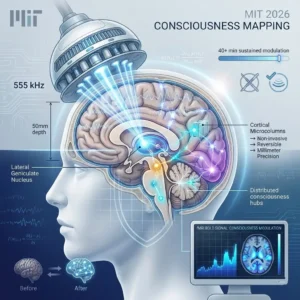
Transcranial focused ultrasound represents a quantum leap beyond existing brain stimulation technologies. The MIT team’s approach uses a sophisticated 256-element helmet-shaped transducer array operating at 555 kHz. Unlike traditional ultrasound imaging, this system focuses low-intensity acoustic waves to precise targets deep within the brain.
The mechanism is elegantly simple yet profoundly powerful. When ultrasound waves converge at a focal point, they temporarily modulate neural activity by affecting ion channel conductance and neurotransmitter release. The effects are:
- Non-invasive: No surgery, no implants, no permanent alterations
- Precisely targeted: Millimeter-scale spatial resolution
- Deep-reaching: Can penetrate to any brain region, including the thalamus and basal forebrain
- Reversible: Effects last 40-60 minutes post-stimulation, then dissipate completely
- Safe: Validated through multiple clinical studies with no adverse effects
The system is guided by real-time fMRI, allowing researchers to verify precise targeting while simultaneously measuring whole-brain effects. This closed-loop approach—stimulate, observe, adjust—opens unprecedented experimental possibilities.
Why Existing Methods Fall Short
To appreciate tFUS’s revolutionary potential, consider the limitations of current brain stimulation technologies:
| Method | Spatial Resolution | Depth Access | Invasiveness | Reversibility |
|---|---|---|---|---|
| TMS (Transcranial Magnetic Stimulation) | Centimeter-scale | Surface only (~2-3cm) | Non-invasive | Reversible |
| tDCS (Transcranial Direct Current Stimulation) | Very diffuse | Limited | Non-invasive | Reversible |
| DBS (Deep Brain Stimulation) | Millimeter-scale | Any depth | Surgical implant required | Requires surgery to remove |
| tFUS (Transcranial Focused Ultrasound) | Millimeter-scale | Any depth | Non-invasive | Fully reversible |
As the table makes clear, tFUS uniquely combines the precision and depth of surgical techniques with the safety of non-invasive methods. It’s the best of all worlds.
MIT’s Research Roadmap: Testing Theories of Consciousness
The real power of tFUS for consciousness research lies in its ability to test causal hypotheses. For decades, neuroscientists have debated between competing theories of consciousness. The two dominant frameworks are:
Global Neuronal Workspace Theory (GNWT): Consciousness arises when information is broadcast widely across the brain, particularly involving prefrontal cortex networks. Conscious perception requires this “global workspace” for integration.
Integrated Information Theory (IIT): Consciousness is intrinsic to systems with high levels of integrated information (measured as Φ). It may not require global broadcasting but rather specific patterns of information integration in posterior cortical regions.
These theories make different predictions about which brain regions are necessary for conscious experience. With tFUS, MIT researchers can now test these directly:
Key Experimental Questions
- What role does the prefrontal cortex play in conscious perception? By selectively inhibiting or enhancing prefrontal activity during visual tasks, researchers can determine whether this region is necessary for conscious experience or merely correlates with it.
- Is consciousness generated locally or globally? tFUS can disrupt specific cortical and subcortical nodes while measuring the impact on conscious perception, revealing whether consciousness requires brain-wide networks.
- How are distant perceptions bound into unified experience? The binding problem—how the brain integrates color, shape, and motion into a unified object—can be probed by selectively modulating connectivity between regions.
- What’s the role of subcortical structures? The thalamus and basal forebrain have long been suspected players in consciousness, but their deep location made experimental testing impossible until now.
- Can we modulate pain perception? We pull our hands from hot stoves before consciously experiencing pain—can tFUS dissect the boundary between subconscious processing and conscious experience?
A Campus-Wide Initiative
This research represents MIT’s signature interdisciplinary approach. The initiative involves over 10 faculty members spanning biology, physics, philosophy, and engineering. Key collaborators include:
- Daniel Freeman (MIT Lincoln Laboratory) – Technical lead and systems engineering
- Matthias Michel (MIT Philosophy and Linguistics) – Consciousness theory and experimental design
- Brian Odegaard (University of Florida) – Perception and cognition
- Seung-Schik Yoo (Harvard Medical School/Brigham and Women’s Hospital) – Clinical applications
The team has partnered with Openwater to use their Open-LIFU (Low-Intensity Focused Ultrasound) device, and experiments with healthy subjects are scheduled to begin in 2026. The research is partially funded by the Department of Defense through MIT Lincoln Labs, reflecting the broad strategic interest in understanding the neural basis of consciousness.
Clinical Applications: Beyond Basic Science
While the theoretical implications are profound, tFUS’s practical applications may be equally transformative. The technology opens new treatment pathways without surgery or drugs:
- PTSD Treatment: Targeted modulation of fear-processing circuits in the amygdala and prefrontal cortex
- Chronic Pain: Disruption of pain-processing networks to provide relief without opioids
- Mood Disorders: Precise targeting of circuits implicated in depression and anxiety
- Addiction: Earlier studies have already shown promise in reducing opiate cravings
The technology has already been validated in previous clinical studies. A 2023 Nature Communications study demonstrated that tFUS could alter GABA concentration in the posterior cingulate cortex—effects that lasted over an hour and altered functional connectivity across multiple brain regions. More recent work has explored applications for long-COVID microclots and substance addiction.
Connection to Quantum Consciousness Research
For readers following our coverage of quantum foundations of consciousness, this breakthrough offers an exciting synthesis. Joachim Keppler’s zero-point field (ZPF) research proposes that consciousness arises from quantum vacuum fluctuations coupling with neural oscillations—a bottom-up field theory of awareness.
tFUS provides the top-down complement: causal manipulation. If ZPF coupling requires specific neural configurations, tFUS can test which configurations are necessary. If certain regions or oscillation patterns are disrupted and consciousness disappears, we gain powerful evidence about the neural prerequisites for field-based consciousness.
The convergence of quantum field approaches with precision neuromodulation represents a new frontier—one where abstract theories become empirically testable. We’re no longer limited to asking “what correlates with consciousness?” but can finally ask “what causes it?”
What’s Next: 2026 and Beyond
The MIT team’s roadmap outlines an ambitious timeline:
- 2026: Begin controlled experiments with healthy volunteers, focusing on visual perception paradigms
- 2027: Expand to multi-modal consciousness studies (auditory, tactile integration)
- 2028: Clinical trials for therapeutic applications pending FDA guidance
The technology will continue to evolve. Current systems achieve remarkable precision, but next-generation devices may offer even finer targeting, faster switching between regions, and integration with other modalities like EEG and MEG for comprehensive neural mapping.
The Dawn of Causal Consciousness Science
For over a century, consciousness research has been constrained by a fundamental limitation: we could only observe, never intervene. fMRI showed us which regions lit up during conscious experiences. EEG revealed the timing of neural events. But correlation, as every scientist knows, is not causation.
Transcranial focused ultrasound changes everything. For the first time, we have a tool that is simultaneously non-invasive, precise, deep-reaching, and reversible. We can now ask the causal questions that have haunted philosophers and scientists alike: Which neural processes are necessary for consciousness? What happens to subjective experience when we selectively silence specific circuits?
The hard problem of consciousness may not be “solved” by any single technology. But with tFUS, we finally have the experimental leverage to make real progress. The neural substrate of consciousness—the physical processes that somehow give rise to the richness of subjective experience—is no longer hidden beyond our reach.
Follow This Research
Stay at the frontier of consciousness science. For more on the MIT team’s ongoing work, visit the Waves Bits Molecules Lab at MIT.
Related Reading on Consciousness Networks:
- Quantum Entanglement and the Nature of Consciousness
- Keppler’s Zero-Point Field Coupling Research
- Markers of Consciousness in Artificial Intelligence
References:
Freeman, D., Michel, M., Odegaard, B., & Yoo, S.-S. (2026). Transcranial Focused Ultrasound for Identifying the Neural Substrate of Conscious Perception. Neuroscience & Biobehavioral Reviews. DOI: 10.1016/j.neubiorev.2025.105842
MIT News (January 12, 2026). “MIT researchers pioneer ultrasound technique to unlock mysteries of consciousness.”
Yaakub, S. N., et al. (2023). Pseudo-continuous arterial spin labeling MRI reveals neuromodulatory effects of transcranial focused ultrasound. Nature Communications.
Nature Communications (September 2025). “High-resolution 256-element transducer array for transcranial focused ultrasound.”
https://www.youtube.com/watch?v=XHOmBV4js_E